

How Monita works
Monita monitors what your real users’ browsers, apps and servers actually send to your marketing and analytics vendors. It doesn’t crawl a handful of pages on a schedule — it observes every session, in production, in real time.
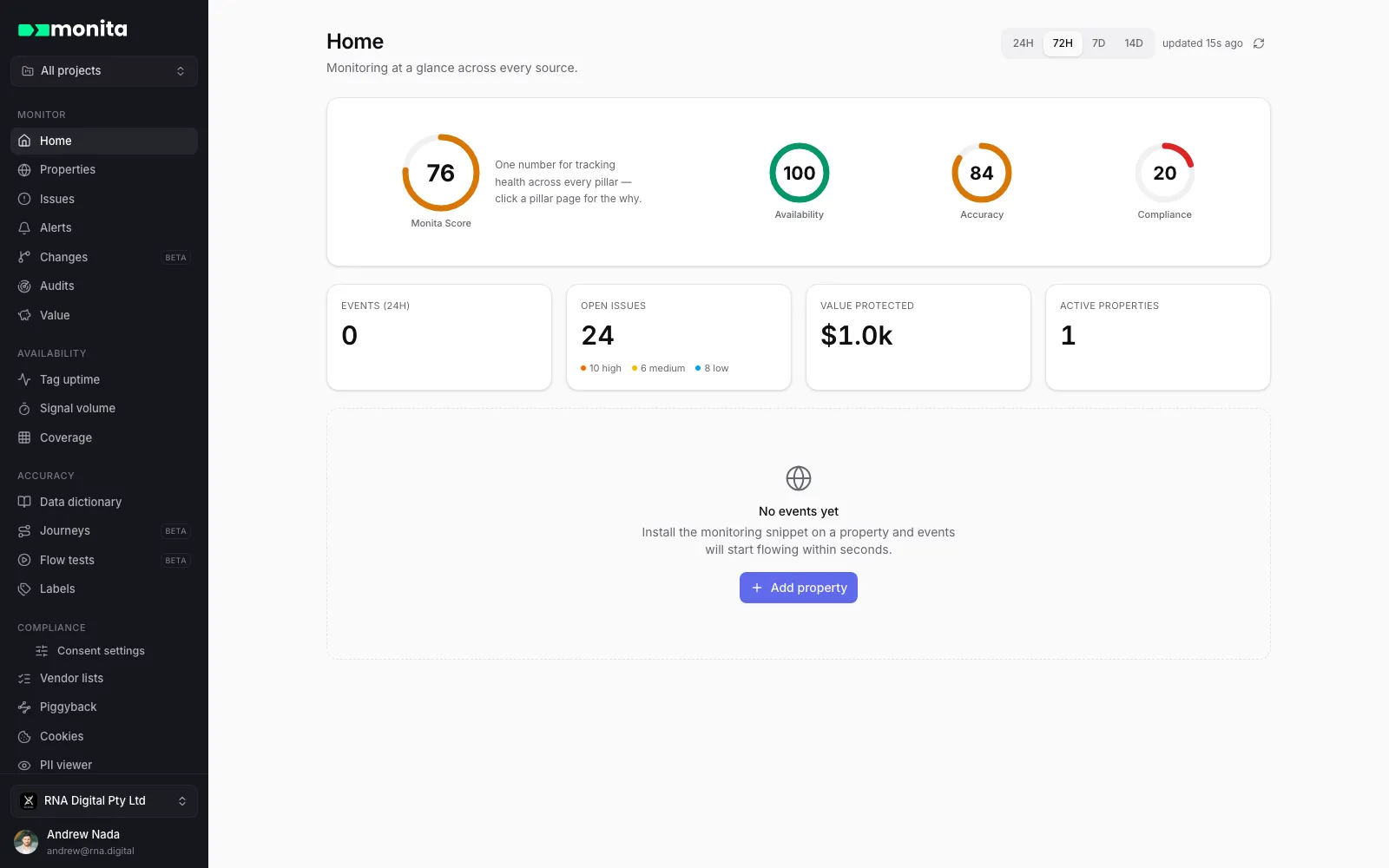
The pipeline, at a glance
Section titled “The pipeline, at a glance”- Collect. A lightweight script (or mobile SDK, or your server-side platform) watches outbound requests to the vendors you care about and streams a copy of each event to
collect.monita.ai. Nothing is blocked or slowed — Monita observes, it never sits in the request path. - Understand. Events are normalized, grouped by vendor and event name, and enriched. Monita suggests labels for events that behave like the same user action, so “purchase”, “order_complete” and “txn” roll up to one meaning, and you confirm or rename them.
- Detect. Automatic engines run continuously on top of the stream:
- Volume anomalies — every hour of traffic for every property × vendor is scored against its seasonal expectation.
- Data drift — payload keys that vanish or change shape versus their weekly baseline.
- Compliance — PII-shaped values in vendor payloads, vendors firing against your policy, consent posture.
- Change watch — new TMS, CMS or CMP releases open watch windows on the signals they can affect, then report passed, regressed or inconclusive.
- Notify. Everything lands in Issues — one funnel across all detectors — and routes to Slack, Teams, Jira, webhooks or email according to your alert rules.
Monitoring vs. crawling
Section titled “Monitoring vs. crawling”Crawler-based tools visit a sample of pages from a data center a few times a day. That misses everything that only happens to real users: consent states, logged-in journeys, geo differences, single-page-app navigations, A/B variants, checkout flows. Because Monita rides along with genuine sessions, if a tag breaks for your users, it breaks in Monita’s data too — usually within minutes.
Monita still includes point-in-time browser audits for the things a crawl is right for: cookie inventories, piggyback chains and pre-release checks on staging.
What Monita is not
Section titled “What Monita is not”- Not a tag manager. Monita never changes what fires on your site. The only exception is the optional GTM integration, which deploys Monita’s own monitoring tag into your workspace — you review and publish.
- Not in the critical path. The script observes and beacons asynchronously; if Monita were ever unreachable, your site and your vendors are unaffected.
- Not a data warehouse. Monita stores telemetry about your tags and payload structure. Detected PII values are SHA-256 hashed in flight and never stored raw — see PII Viewer.
Where events come from
Section titled “Where events come from”| Source | How it works |
|---|---|
| Websites | One global script, deployed via any tag manager or directly on the page. One token covers any number of hostnames. |
| GTM containers | Monita’s approved tag template runs inside your container and reports on every tag it sees fire. |
| iOS & Android | SDKs observe outbound vendor traffic from your app. |
| Server-side | Your Adobe Event Forwarding property, server GTM, Tealium EventStream, Segment or any HTTP-capable platform posts events to the collect API. |
Ready to try it? Start with the Quickstart.